Supreme Court Recognizes Corporate Guarantees as Financial Debt, Overturns NCLAT and NCLT Orders, State Bank of India and Consortium of Banks Declared Financial Creditors in Landmark Judgment by the Supreme Court of India
In a significant ruling, the Supreme Court of India on April 28, 2026, recognized corporate guarantees as "financial debt" under Section 5(8) of the Insolvency and Bankruptcy Code, 2016 (IBC), in the case of State Bank of India & Ors. v. Doha Bank Q.P.S.C. & Anr. This decision overturned prior judgments by both the National Company Law Appellate Tribunal (NCLAT) and the National Company Law Tribunal (NCLT), which had dismissed the claims of the State Bank of India (SBI) consortium, comprising several prominent banks, as financial creditors.
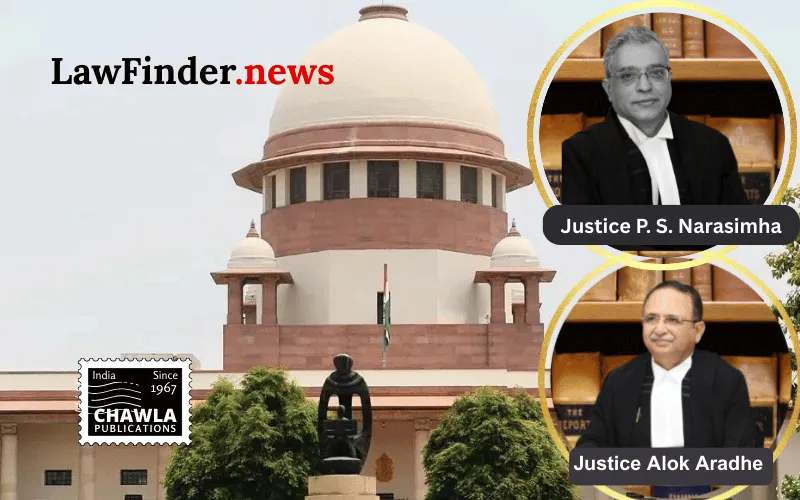
The bench, comprising Justices Pamidighantam Sri Narasimha and Alok Aradhe, held that liabilities arising from corporate guarantees indeed constitute financial debt as per the IBC. Consequently, the court recognized the appellants, a consortium of banks, as financial creditors of the corporate debtor, Reliance Infratel Limited (RITL).
The judgment addressed the appellants' contention that corporate guarantees executed by the corporate debtor should be recognized as financial debt, thereby entitling the consortium to be classified as financial creditors. The court further found that the objections raised by the respondents, regarding the timing and manner of the execution of the corporate guarantees, lacked merit.
The apex court ruled that insufficient stamping of a document does not render it void or unenforceable, terming such defects curable. This interpretation is consistent with the court's view that the Stamp Act is a fiscal measure intended to secure state revenue and should not be used as a litigation tool.
In its detailed analysis, the court clarified that the guarantees were executed within a framework of restructuring obligations, thereby dismissing claims that they were invalid due to the debtor's already classified non-performing asset (NPA) status. The ruling emphasized that the timing of the guarantees’ execution, before the debtor’s account was declared an NPA, was crucial.
The Supreme Court's decision effectively quashes the NCLAT and NCLT orders, directing the reconstitution of the committee of creditors, including the appellants, to proceed with the corporate insolvency resolution process according to law. This ruling is poised to have significant implications for the recognition of financial creditors in insolvency proceedings and the enforceability of corporate guarantees in India.
Bottom Line:
Corporate guarantees executed by a corporate debtor constitute "financial debt" under Section 5(8) of the Insolvency and Bankruptcy Code, 2016. Insufficient stamping of a document does not render it void or unenforceable, and such defects are curable.
Statutory provision(s):
Section 5(8) of the Insolvency and Bankruptcy Code, 2016, Sections 43, 45, 66 of the Insolvency and Bankruptcy Code, 2016, Maharashtra Stamp Act, 1958.
State Bank of India v. Doha Bank Q.P.S.C., (SC) : Law Finder Doc id # 2889984